 SyncDrift: Timecode CheckHelp
Keep the log review with its sources.
Reconcile two explicitly mapped production logs, carry accepted pairs and unresolved records in a review ZIP, and save a paired observation run only when its timing meaning is declared.
For production sound recordists, camera assistants, DITs and film students working from their own files. iPhone and iPad. No equipment connection or automatic media synchronization.
Review both logs before fitting a trend.
Choose the reference and device CSV/TSV files independently. Select each file’s exact key, timecode and optional day column, then confirm the shared frame rate and any all-Day-0 interpretation. Only unique, exact, case-sensitive keys present once on both sides become accepted pairs. No fuzzy matching, nearest-time pairing, rate inference or midnight-rollover guess is made.
Duplicate, unmatched, malformed, invalid-timecode and non-advancing records remain review issues, with their logical source-record numbers. A matching clip or take key does not establish that the two clocks were read at the same instant.
Export the review, even when no records pair.
After a valid mapping/rate/day interpretation is available, Prepare review files creates a local inspection packet without admitting a same-instant event. It also works with zero accepted pairs. Share the complete Reconciliation.zip or individual review files.
The packet keeps both received logs byte-for-byte, their filenames and SHA-256 fingerprints, explicit mappings, generated accepted observations and every review issue. A zero-pair Matched-observations.csv contains only its header. The review creates no drift fit or saved run and is not a restorable Run.json backup.
Declare the event before interpreting clock drift.
To save a two-log observation run, the operator must describe the shared event and explicitly confirm that every matched pair records both clocks at the same physical instant. A common clip/take ID or separate recording starts are insufficient. The app records this operator statement; it does not independently verify it.
Restored older runs without a declaration remain unconfirmed. Source readings and review issues stay available, while clock drift and projection are withheld. Revising or revoking the declaration does not rewrite the original logs or previously exported files.
Keep the run and your decisions.
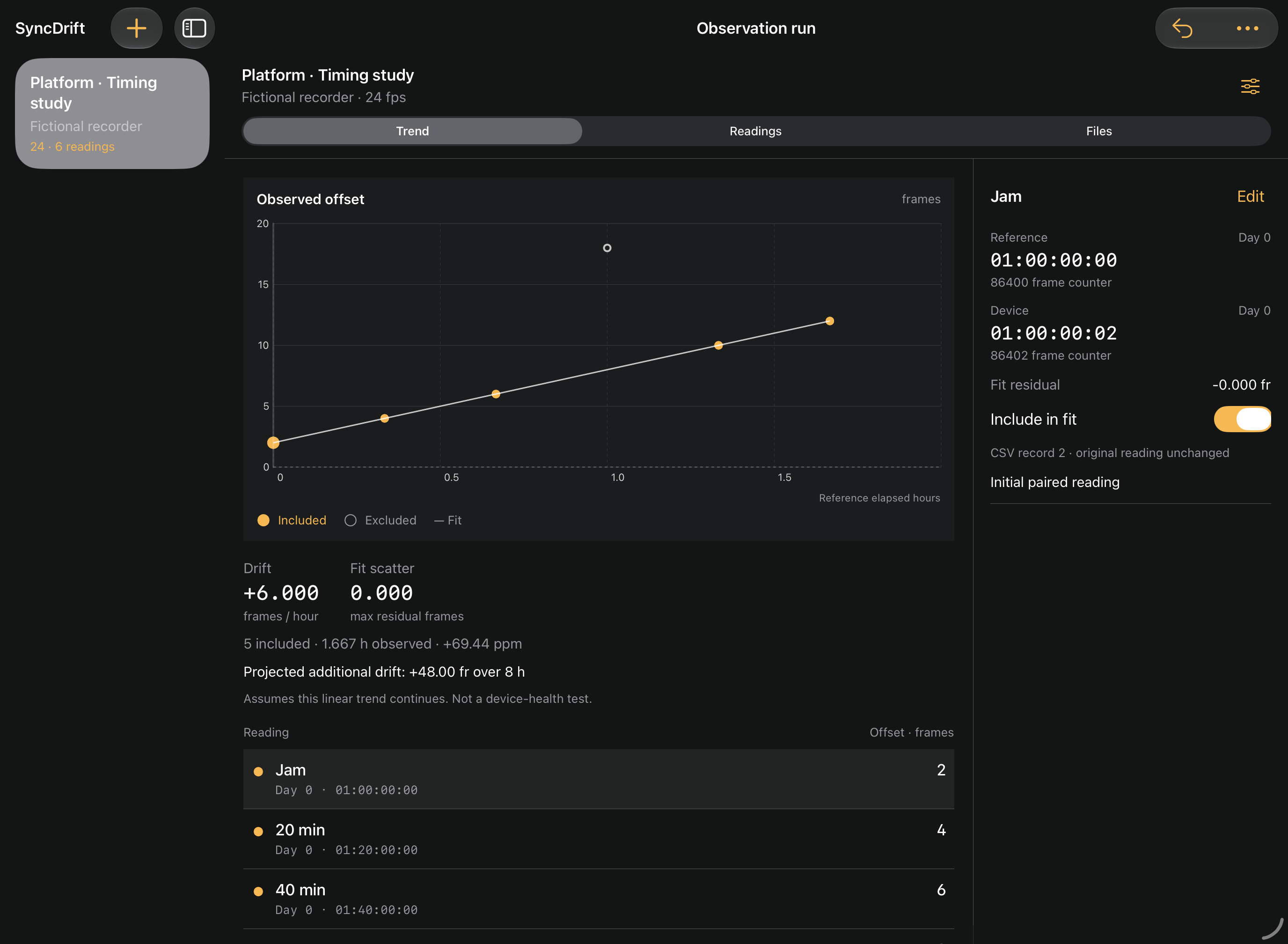
A saved run retains paired readings, notes, inclusion choices, its declared event meaning where required, and original source bytes. Inspect frame counters and residuals. Excluding a reading is your decision; the original imported value remains unchanged.
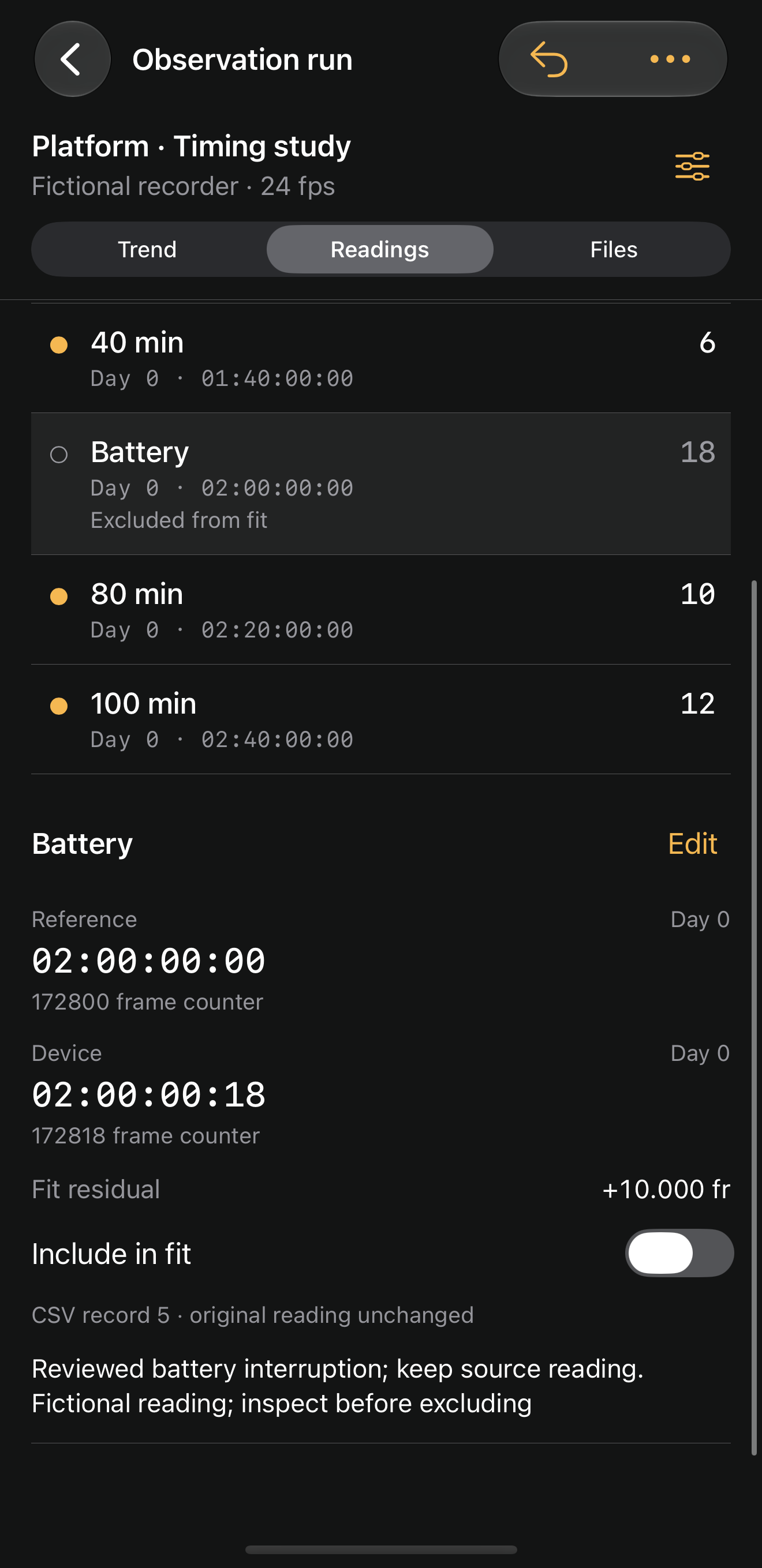
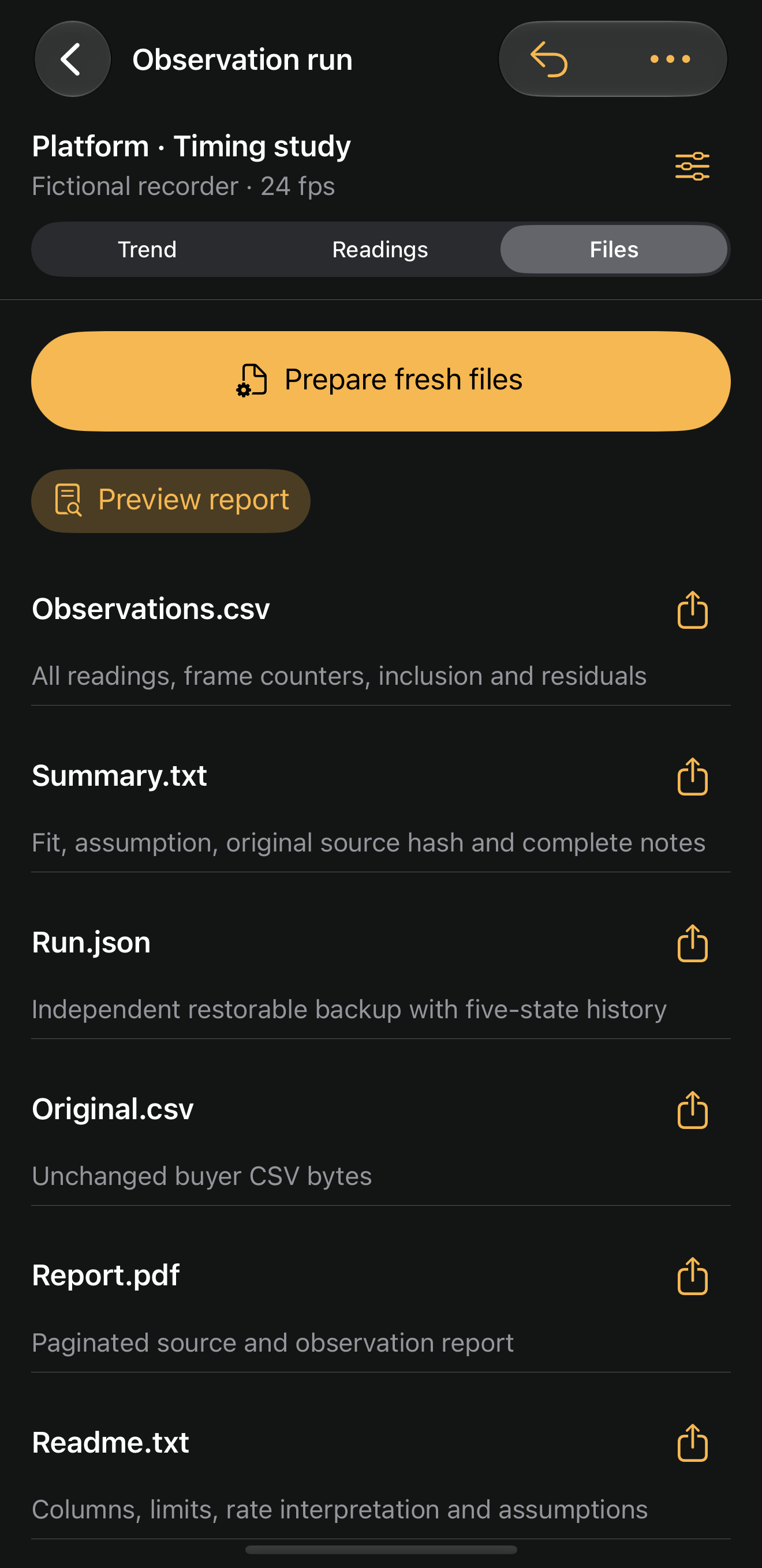
Run exports can include Observations.csv, Summary.txt, Run.json, a paginated Report.pdf, original/canonical source files, Readme.txt, SHA256.txt and Run.zip. Restore Run.json as an independent run, including its bounded recent history. Keep an external copy before removing app data.
A bounded manual tool.
Six supported rates include exact 24000/1001 and 30000/1001. Explicit day 0/1/2 values count timecode-label-day rollovers, not calendar dates or inferred midnight. A linear fit describes included readings; it does not certify device health or future behavior. Two readings fit exactly and do not establish consistency.
Each two-log input: up to 1 MiB, 1,000 data records and 32 columns. Accepted observations: up to 200. Saved runs: up to 40; JSON: 4 MiB/run; local library: 161 MiB. PDF is limited to 400 pages; a limit explanation replaces it while other complete exports remain.
Read formats, calculations and recoveryExisting fictional six-column CSV demonstrates the manual-observation importer, not two-log reconciliation. It is not field data.